Introduction
Lesley STEAM or LSTEAM supports authentic learning that doesn’t supplant what happens in school, but introduces teachers and students to concepts and hands-on experiential skills, using a novel schema for knowing, thinking, and doing in mathematics. For three years, LSTEAM has designed and implemented this approach to bridge mathematics and making. T with the aim was to ignite mathematical curiosity by reinforcing K-8 math skills through culturally relevant hands-on learning. Our approach included developing CRIME toolkits such as Math & Quilting, Tangrams, and Crazy Contraptions, and offering Instructables for teachers via a website dedicated to sharing DIY, step-by-step, project-based instructions. It serves as a platform for makers to document, learn, and collaborate.
Read more: Culturally Relevant Math ExpressionsCulturally relevant hands-on learning is an instructional approach that engages learners through active, experiential tasks (e.g., making, creating) designed to connect new concepts directly to their cultural backgrounds, lived experiences, community and personal references. It empowers learners by affirming their identity, fostering critical thinking, and utilizing cultural knowledge as a scaffold for deep academic achievement (Ladson-Billings, 1995). Key characteristics and components include focusing on utilizing learners’ existing cultural knowledge and strengths; incorporating cultural references,, traditions, and community knowledge into practical activities; mapping or creating artifacts that connect academic content to relevant, real-world issues; and using toolkits that provide curated, evidence-based resources, strategies, and templates that streamline teaching and learning processes, allowing educators to implement best practices effectively.
During each professional development workshop, teachers received toolkits with materials and links to online Instructables such as 10×10 Conversion Quilt Making, an educational or design technique that involves translating numerical data—specifically fractions, decimals, and percentages—into visual, geometric fabric and 2D foam shape designs, often using 10×10 or 5×5 grids to represent a “whole” (100% or 1.0). They color, design, and calculate the proportions of different colors or shapes, converting them between fractions, decimals, and percentages. During professional development workshops for teachers across the United States, participants were shown how to use their toolkits to physically render their math-based designs. The following sections further describe these kits and the activities that are centered on culturally relevant math.

Math & Quilting
Our Math & Quilting Toolkit blends quiltmaking with mathematical thinking for grades K-8. It includes supplies and guides for exploring patterns, symmetry, geometry, fractions, and measurement through quilt design and construction. By combining grade-appropriate literature, fabric, templates, grids, and pacing guides, the toolkit helps learners see math as tactile, visual, and deeply connected to diverse quilting traditions. Toolkits include quilt design templates from Gee’s Bend, Alabama, Appalachia (Eastern U.S.). Lakota (Sioux), and mandalas (Buddhism). In addition to the 100-square grid, a smaller 5×5 or 25-square template emphasizes the use of 3D foam shapes with adhesive backing, such as triangles and rectangles, and making quilt patterns requires understanding how these shapes fit together. Books such as The Quilts of Gee’s Bend (2017) and Stitchin’ and Pullin’: A Gee’s Bend Quilt (2016) are provided to help ground teachers and students in the history and traditions of quilt making. Here is an excerpt from the latter:
[T]he girl’s grandma explains the meanings and feelings behind each colored cloth. “Blue cools. / Red is loud and hard to control, / like fire and a gossiping tongue.” Green, orange, yellow, white, pink, and all the others have their own personalities. “Grandma says, / ‘Colors show how you / feel deep down inside.’”

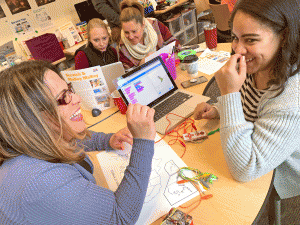
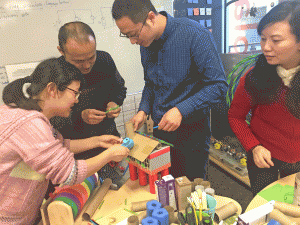
The LSTEAM team led in-person teacher workshops that included hands-on work and physical rendering of quilt designs. The toolkit enabled participants to learn about and recognize quilts from different cultures and identify and use math concepts to make quilts. Participants also learned how to adhere their physical quilt designs to canvas bags using the ‘appliqué’ method. We also integrated advanced work on soft circuits by embedding electronic components for use on these physical quilts using tools such as conductive fabric tape, conductive thread, LEDs, and sensors.

Tangrams
Our Tangram Toolkit builds on the Math + Quilt design templates and uses tangrams to make mathematical concepts visible and intuitive. Tangrams are Chinese geometric puzzles consisting of a square cut into seven pieces that can be arranged to make various other shapes. Through tangram pieces, literature, and design prompts, learners explore geometry, spatial reasoning, fractions, and problem-solving by building and transforming shapes. The toolkit encourages making and mathematical thinking through tactile exploration. This toolkit includes the book Grandfather Tang’s Story (1990) that uses tangram pieces to tell a story. After reading the story, participants can choose animals to make with the tangrams.

Crazy Contraptions
Our Crazy Contraptions Toolkit invites learners to design, build, and tinker with playful, chain-reaction (simple) machines. Using levers, pulleys, wheels, ramps, and connectors, the toolkit introduces core physics and engineering concepts like force, motion, and energy transfer. Through experimentation and iteration, learners discover how simple machines work together to create complex results. With this toolkit, participants can watch a Netflix Jr. Crazy Contraptions & Fabulous Forts video clip that features ‘Ada Twist, Scientist’ and her friends who brainstorm and come up with new ways to solve problems using mechanical engineering. The main character (Ada) is inspired by real-life female scientists like Ada Lovelace and Marie Curie, aiming to promote STEM, perseverance, and curiosity. This toolkit also includes two books that inspired this video clip, Ada Twist, Scientist (2016) and Rosie Revere, Engineer (2013).

In both in-person and virtual CRME workshops educators were provided with a comprehensive toolkit of materials that could be used to reinforce culturally relevant learning in math for the students in their classroom. We gathered feedback from our work through a series of post-workshop questions to help educators with their reflections on their experiences with us.
When asked to think about identity (with a focus on underrepresented populations in STEM/STEAM):
- “Understanding identities is key to deliver equitable instruction in the classroom”
- “Our identity impacts both how we show up and how we feel a sense of belonging in a space
How does quilting and math increase curiosity in students?
- “Noticing patterns and cutting to precise size, and connecting parts like puzzles”
- “Allows students to see real world applications – they can see how it can be used in real life”
- “Helps them to solve problems in different ways”
How will you apply this knowledge into your teaching practices?
- “Definitely being more intentional in embedding culturally relevant experiences”
- “I can get creative and implement art”
Lesley STEAM noted the slow expansion of our work in new communities, local and national, as a powerful indicator of success and growth. In addition to facilitating CRME workshops in the United States we worked with international delegations who were interested in best practices in STEAM education in U.S. Higher Education. We were able to share some of the activities created for CRME with representatives from Vietnam, India, Japan, Ireland, and Moldovia.
References
Beaty, A. (2013). Rosie Revere, Engineer. Abrams Books for Young Readers.
Beaty, A. (2016). Ada Twist, Scientist. Abrams Books for Young Readers.
Ladson-Billings, G. (1995). Toward a Theory of Culturally Relevant Pedagogy. American Educational Research Journal, 32(3), 465–491. https://doi.org/10.2307/1163320
McKissack, P., & Cabrera, C. A. (2016). Stitchin’ and Pullin’: A Gee’s Bend Quilt. Dragonfly Books.
Rubin, S. G. (2017). The Quilts of Gee’s Bend. Abrams Books for Young Readers.
Tombert, A. (1997). Grandfather Tang’s Story. Dragonfly Books.